
Flavours in the Mail: Postcards from the East Indian Coast
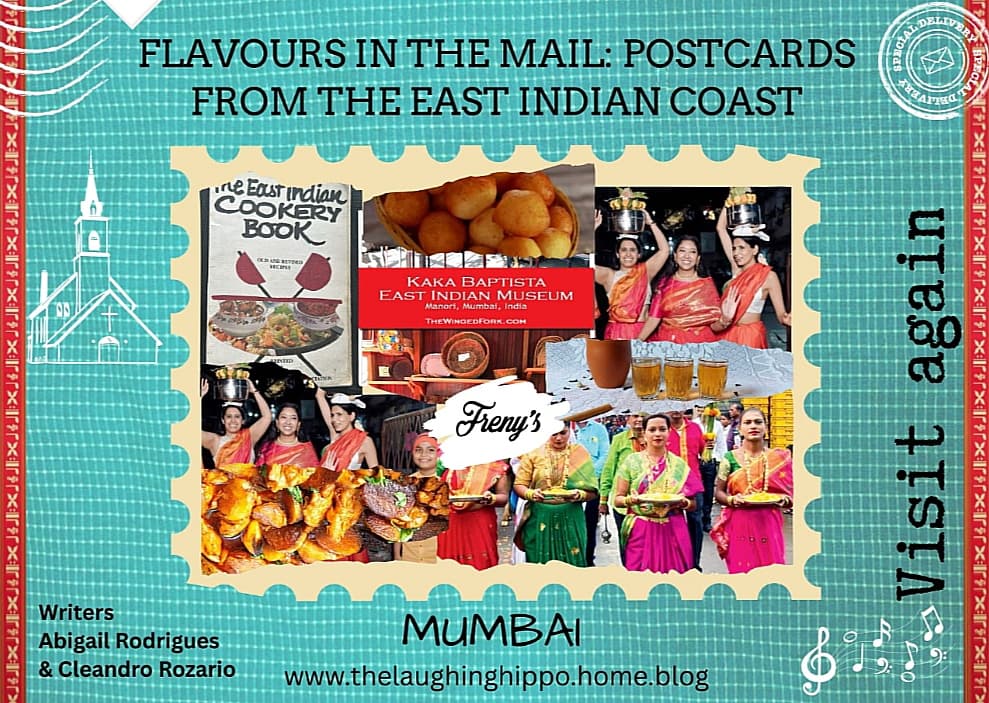
This piece is our postcard from the East Indian community—a snapshot of their lives told through the flavours that they treasure most. After all, food speaks louder than words. Their culture blends folk Catholicism, Portuguese heritage, and regional traditions, which are carried through language, dress, and music. In a city that rushes, they cook slowly and season each dish with patience, purpose, and prayer.
Often misunderstood by name, Mumbai’s East Indians aren’t from the East of India. They are among the city’s oldest communities and refer to Bombay as Mobai. Converging on the island of Bombay from different parts of the suburbs, the East Indians embraced Catholicism during Portuguese rule yet preserved a culture that is uniquely their own—rooted in Marathi traditions, flavoured by Portuguese influences, and seasoned with the coastal abundance of Maharashtra.
In East Indian homes—from the winding lanes of Bandra to the breezy coast of Vasai—food isn’t merely served. It is prayed over, passed down through generations, and offered into the hands of those both grieving during funerals and rejoicing at Christenings and weddings. Recipes carry memory, meals carry faith, and kitchens become sacred spaces where life is honoured with every spoonful. The clink of ladles often meets the murmur of prayers or the swell of hymns—Grace before meals, harvest blessings and wedding choirs. Cooking is both care and worship—each dish an offering, each flavour a note in the community’s song of praise.

The traditional Lugra sari

The Koli dance of the East Indian Koli community
However, all has not been good for the East Indian community. Their culture is speckled with blotches of exploitation and discrimination. Due to their unique Luso-Indian (Portuguese-Indian) heritage, the newer settlers of Bombay refused to recognise East Indians as local inhabitants, causing them a major identity crisis. This worsened when they weren’t considered pioneers of Bombay culture despite their indispensable contributions to it. Their heritage struggled to survive in the face of gentrification. East Indians educated in the English education system began moving to other parts of the country or abroad in search of better opportunities. Their dwindling numbers heightened the panic of a community that was already afraid of getting wiped off the map.

The museum documents East Indian heritage
However, the community has made significant conservation efforts led by its youth. This has resulted in the eventual re-establishment of the East Indian community within the fabric of Bombay. A culture that has historically faced challenges due to urban sprawls and cultural erosion now takes pride in its unique identity. The establishment of the ‘Kaka Baptista East Indian Museum’ in Manori, the growing popularity of culinary staples like bottle masalas and fugyas, and music like the beloved Paskin, has finally brought the East Indian community the recognition it deserves. The gaothans (traditional settlements), which were once looked down upon, are now seen as a fun way to mix with others from the community and retain the strength of their ties.
In the face of change, food has remained a reassuring constant. Connecting food to traditions, East Indian ceremonies are steeped in flavour, memory, and meaning across life. At birth, nourishment begins immediately—new mothers are served haldi-infused broths and rice kanji to restore strength. Christenings bring families together over simple, heartfelt spreads and sweet bolings. As children grow into adults and love blossoms, pre-marriage rituals mark the transition into a new chapter. The Poth ceremony, brimming with song, laughter, and communal cooking, sets the tone for celebration. Umbracha Paani—a symbolic blessing with water—draws families close in preparation for the wedding day.
When vows are finally exchanged, the wedding feast bursts with faith and flavour: kimad toasts, baskets of airy fugyas, rich sorpotel, fragrant moile, and plates of thalie sweet. In East Indian weddings, each dish is a blessing—fugyas for prosperity, sorpotel for life’s flavours and kimad for joy. Food is cooked together as stories and traditions are shared. Beyond personal milestones, the community also celebrates its bond with the land through Agera, the harvest festival. Here, freshly cut paddy is blessed, symbolising gratitude for abundance, and is followed by a feast that honours God’s provision and the farmers’ toil.

A spread featuring East Indian delicacies

The iconic fugyas
Yet food carries comfort in times of loss. At funerals, neighbours arrive quietly with humble meals—dal, rice, beef curry—offering sustenance that grounds the grieving without overwhelming them. In the East Indian way, healing is never solitary. Eating together softens the ache without demanding words. Whether it is a steaming pot of moile, a wedding sweet, or a shared harvest meal, these acts are more than hospitality. They are a sacred language of solidarity, where every bite is a blessing and every gathering is a reminder that no one celebrates or mourns alone.
To savour authentic East Indian flavours, visit Freny’s Kitchen (@frenyskitchen, Bandra) for pork vindaloo, fugyas, and coconut desserts. House of East Indian (@houseofeastindian, Andheri) serves hearty Sunday meals via its cloud kitchen. For a true community vibe, head to Church Fairs in Orlem, Bandra, or Kalina during feast days and Christmas, where stalls brim with thalie sweet, moile, and glasses of kimad—each bite a slice of East Indian heritage.
In East Indian homes, food is tradition—a reflection of touch, time, and tenderness. It shares joy, softens grief, and ensures love is never served alone. Their communal culture bridges time, place, and change. It binds generations through songs, recipes, and rituals that are carried from ancestral gaothans to modern Mumbai and root their community spirit through centuries of change. The East Indian community’s experience exemplifies an ongoing dialogue between cherished traditions and the necessities of modern urban life. Through innovative self-expression and conscious heritage revival, they have carved a niche for themselves in Mumbai’s diverse mosaic. Their resilience and adaptability ensure that their community remains vibrant, respected, and integral to the city’s history and soul. We are truly grateful to Andrea Aguiar (SYBA) and Charista Coelho (TYBA) for their first-hand insights, which rendered this piece with nuance and attention to detail.
Comments (0)
Sign in to leave a comment