
Tanabata Festival
With love’s light wings did I o’erperch these walls,
For stony limits cannot hold love out,
And what love can do, that dares love attempt.
~ William Shakespeare, Romeo and Juliet
Once upon a time, there lived a beautiful princess named Orihime. She was the daughter of the King of the Sky, Tentei. She was a gifted weaver, and dedicated her life to her craft. But although she loved her work, Orihime was immensely lonely. Day after day, she would sit by the banks of the Amanogawa—the Heavenly River, or the Milky Way—and weave, wishing with all her heart that she could find a companion in her dreary life.

Photo by Graham Holtshausen on Unsplash
Tentei was a harsh man, prone to anger and impulsive outbursts. Yet even he had a soft spot for his only child, and could not stand seeing her so unhappy. So, in an attempt to lift her spirits, he introduced her to one of his subjects—Hikoboshi, a cow-herder.
The second Hikoboshi and Orihime locked eyes, all was lost. The two fell head over heels in love. Hikoboshi was struck not only by Orihime’s beauty, but also her talent, passion and kind heart. And Orihime, for the first time in her life, knew what it felt like to be accepted unconditionally. As the daughter of a king, she had grown up around opulence. Hikoboshi showed her a different way of living—one that was perhaps less luxurious, but far more fulfilling.
Gradually, their courtship bloomed into a happy marriage. The two would roam the kingdom together, enjoying all the marvels the world had in store for them. Orihime would weave intricate tapestries for Hikoboshi, entwining in each thread the love she felt for him. Hikoboshi would show her skies lit up by a thousand stars and whisper that she was lovelier than each one. In those moments, Orihime felt like she had found her true purpose.
But in the meanwhile, trouble was brewing. Tentei, usually absorbed in his own duties, finally noticed that both Hikoboshi and Orihime had begun neglecting their work. He searched the entire galaxy and, at last, found the two of them together. In a fit of blind rage, he seized Hikoboshi and cast him across the Amanogawa. He thundered that it had been a mistake to ever let Orihime get distracted, and swore she would never see her lover again.
Orihime was beyond distraught. She wept for days on end, begging for her father to see reason. If she had neglected her weaving earlier, she was now unable to create a single piece. Her grief overshadowed everything else. When Tentei realised that she would perhaps never get over the loss of Hikoboshi, he conceded—if both he and Orihime worked hard, they could see each other once a year, on the seventh day of the seventh month.
Orihime felt as though she had been given a new lease on life. She began to work frantically, spending her days and nights weaving without any rest. The thought of seeing Hikoboshi again carried her through hours and hours of toil. Until, finally, the time came for them to meet.
At long last, Hikoboshi and Orihime stood on opposite sides of the Amanogawa. But…how were they to cross the river? It stretched out before them, seemingly endless and impossible to face. Orihime covered her face with her hands and began to wail. She had come so close to seeing her beloved, but life had been cruel to her yet again.
Orihime’s cries attracted a flock of magpies from nearby. Curious, they flew to the sobbing girl and asked what the matter was. Orihime narrated her tale, explaining how her separation from Hikoboshi had been prolonged. The magpies were touched and decided they had to help the young couple.
And so, they gathered together and stretched their wings out to form a bridge across the Amanogawa. Overjoyed, Orihime and Hibokoshi ran across the bridge and leapt into each other’s arms.
Every year, the magpies would return on the same day and form their majestic bridge. And for a few brief moments, the star-crossed lovers would reunite.
This timeless tale is the origin of the Tanabata festival—literally, the seventh evening of the seventh month. Interestingly, it was not originally derived from Japanese mythology or customs. What started as the Chinese Qixi Festival gradually took the shape of a distinct Japanese cultural tradition. Two different societies can inherit the same story while celebrating it in their own ways. Cultural traditions are living entities that undergo change while preserving traces of their history. Over time, these traditions can even diverge within the same culture, giving rise to unique regional practices.
In Sendai, Japan, in 1927, local merchants revived the Tanabata Festival, which had been on the verge of extinction in the region due to economic recession and changing social circumstances. They decorated shopping streets with elaborate paper ornaments, transforming the festival into a form of public cultural expression and a source of civic pride. This may seem different from the more familiar tradition of tying a written wish to a bamboo branch, but that is the beauty of living traditions. Every community can celebrate a festival in its own way, shaped by the cultural, historical, and social influences that evolve within its environment.
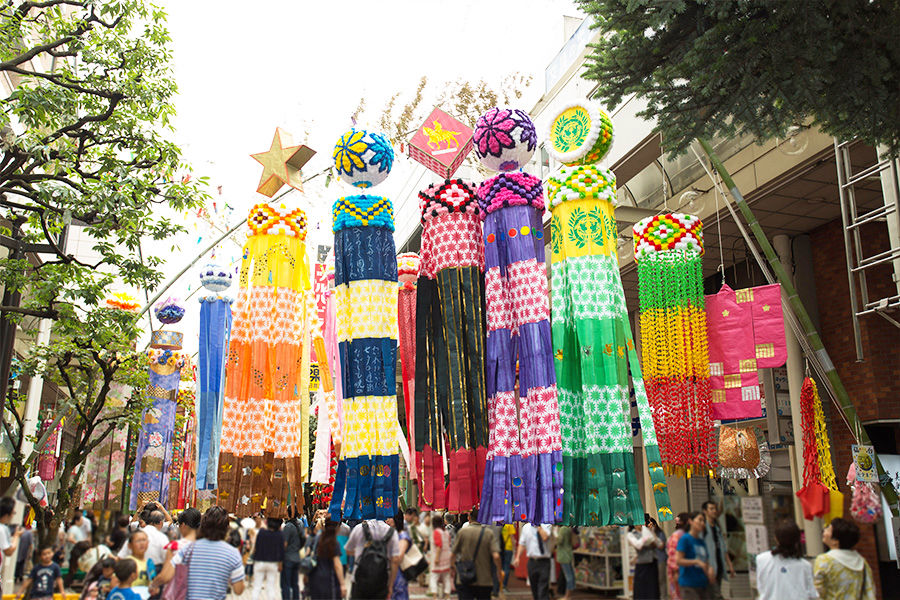
Sendaii’s Tanabata Matsuri
Art has always been one of humanity's earliest forms of self-expression. Long before words found their way through verbal articulation, emotions found their way into paintings, sculptures, books, music, dance and countless other forms of creativity. Festivals often become a canvas for an entire community to express itself, and Tanabata is no exception.
Today, the Tanabata festival is one of the biggest and most vibrant summer celebrations in Japan. It is centered around hope by means of making wishes for the future. This has given rise to a number of lovely traditions, the most popular one being tanzaku (a small colourful strip of paper) making. People write down their wishes on tiny slips of paper, which are then tied to stalks of bamboo with thread. This can be done by a single person, a classroom, a family, or even the general public. In fact, in many places, branches of bamboo are set up so that anyone can write and hang their wish.
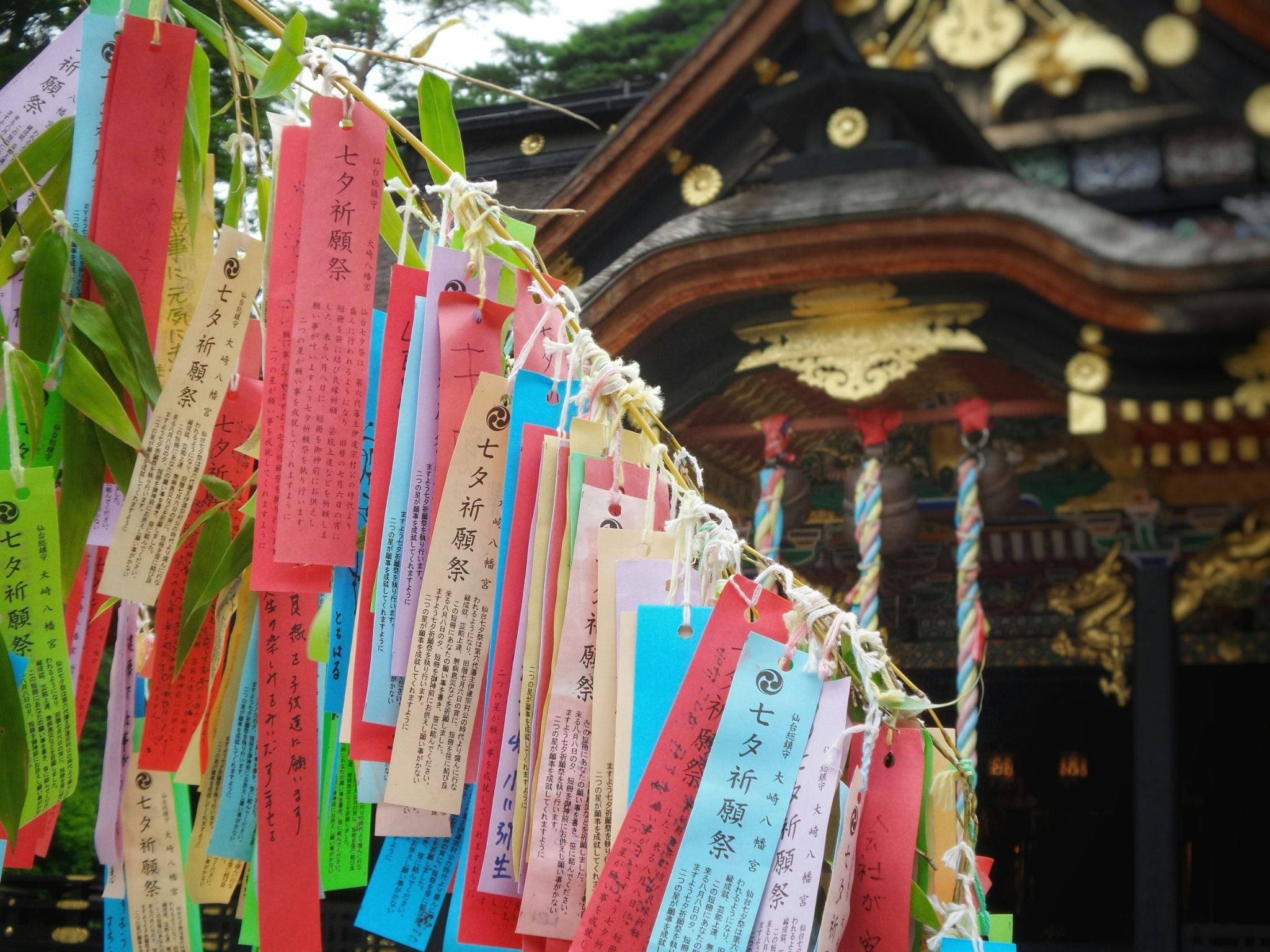
Photo by Franck V. on Unsplash
The festival also celebrates traditional Japanese craftsmanship through decorations collectively known as sasakazari. Paper streamers (fukinagashi), paper cranes (orizuru), purses (kinchaku), nets (toami) and other ornaments are not merely decorative objects. Each carries its own symbolism and has been passed down through generations as part of the festival's artistic heritage. In many regions, schools, families, local artists, and neighbourhood associations work together to create these decorations, turning streets into vibrant displays of colour and craftsmanship.
These externalities of the Tanabata festival form a huge part of Japanese culture and are undeniably important. And yet, we must go beneath the surface to understand its deeper meaning.
Among the oldest stories humanity has told are those written in the stars. While chasing meaning, many found answers nowhere, not even in the stars. Yet the stars always seemed to resonate with the feeling that we belong to something greater than ourselves.
As Carl Sagan famously wrote,
The cosmos is within us. We are made of star-stuff. We are a way for the universe to know itself.
In many cultures, children are told that their loved ones become stars after they pass away, and they often accept it without question, as if the stars have always belonged to us in some way.
Evidently, humans have always related themselves to the stars through stories of hope, longing, belonging, and beauty. The legend behind the Tanabata Festival is made of the same "star-stuff" Sagan spoke of. Altair and Vega, separated by the Milky Way, sound poetic, yet the symbolism is deeply human. There may be countless interpretations of this celestial resemblance, but it is fascinating to see how our most fundamental emotions shape the stories we tell about the universe and, in turn, about our culture.
The legend is also rooted in seasonal observations along with its astronomical significance. The festival is celebrated during the Japanese summer, when the stars Altair and Vega, and the Milky Way, are most prominently visible in the night sky after the rainy season has largely passed. The timing of Tanabata is therefore not arbitrary. It reflects the close relationship that traditional societies maintained with the rhythms of nature, where seasonal changes were not merely observed but woven into cultural practices and celebrations. In this way, the night sky becomes more than a backdrop for the legend; it becomes an active participant in keeping the tradition alive.
For the Department of Inter-Religious Studies, the Tanabata festival was an opportunity to celebrate not only the hope and goodwill that it signifies, but also the richness of Japanese culture. These two elements were seamlessly woven together as students joined in the festivities.
In keeping with the spirit of the festival, people were asked to create their own tanzaku by writing down their wishes on little slips of paper. These were then used to replicate the bamboo branches of Tanabata by combining all the wishes into a wall hanging. There is something inexplicably beautiful in this simple act of dreaming collectively. People may have wished diverse wishes, but what brought them together was putting their hope in a better future. And the wall hanging—a hotchpotch of colours, scribbles, and dreams—stood testament to that.
Of course, it takes more than hope for a wish to come true—hard work, perseverance, and dedication of the kind Orihime herself had. Dozens of students trusted us with their wishes to safekeep for the next six months. As they work hard over the next half-year, we will preserve the goals they are inching towards. And in February, we will be emailing them these dreams so they can see how far they’ve come.
DIRS also conducted games and activities celebrating Japanese culture. One of these was Konpira Fune Fune, a game traditionally played by the geishas (traditional female entertainers) of Japan. It tests the participants’ rhythm, reflexes, and quick thinking.
That, perhaps, is the artistic beauty of Tanabata. It does not separate art from everyday life. A handwritten wish, a folded piece of paper, or a carefully crafted decoration may not be considered a masterpiece, yet together, they transform an ordinary street into a living expression of hope, creativity, and community. In Tanabata, art is not something to be observed from a distance. It is something every member of society contributes to, no matter how small their contribution may be.
Comments (0)
Sign in to leave a comment