
When the Light Turns Inward
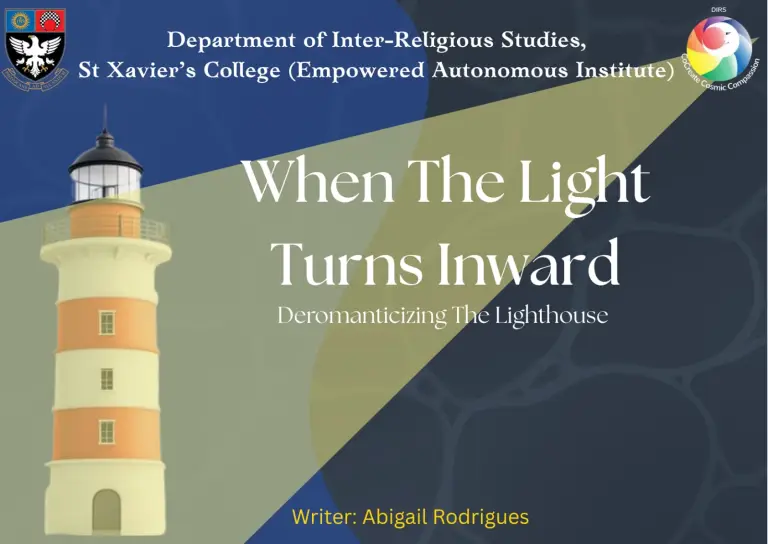
One of our final blogs for the academic year, this piece re-interprets the concept of a lighthouse in keeping with the Lighthouse Series. It shines light on the inner life of lighthouses; people who are primarily defined by the light they channel for others as their needs gather dust in the shadows. It invites us to expand our perspective of the lighthouse so that love, warmth and illumination reach everyone, especially those who spend their time giving it to others. The writer has curated a special playlist reflecting her interpretation of a lighthouse which you will find it at the end of the blog. Happy Reading!
We admire light because it cuts cleanly through the night. We photograph the beam, not the tower. From a distance, the lighthouse looks heroic- solitary against weather, patient with tides; unwavering while everything else moves. There is something deeply reassuring about a structure that does not bend, something comforting about the promise of constancy when the world feels unstable.
It is easy to turn this image into praise for people who seem similarly steady. We call them anchors, constants and dependable ones. We trust them to hold the emotional weight of rooms, families, friendships and crises. They become reference points that are quietly consulted whenever things feel uncertain or overwhelming.
Yet the picture has another side that postcards rarely show: every lighthouse throws a long shadow behind its own body. The brighter the outward beam…the darker the space it leaves unlit within. This shadow is not accidental; it is structural. We rarely walk around to look at it, perhaps because doing so unsettles the story we prefer to tell.
The idea of the ‘lighthouse person’ is tender and intoxicating. It suggests someone who always knows where the shore is, who remains upright when conversations tilt, who speaks with a calm that makes panic step aside. They are the friend who answers messages at 3 am without mentioning they have an exam at 9. The one who says, “It’s okay, tell me everything”, and means it, while their own stories are compressed into two sentences. They don’t make a spectacle of themselves or shatter in public. They listen. They absorb. They keep the light running. From the outside, they embody strength in its most graceful form.
But lighthouses do not shine inward….
Their purpose is to project the beam outward– a slow, sweeping arc meant for other lives, journeys and storms. Inside, the rooms often remain dim, the spiral staircase carries dust and the windows face only one direction. The staircase is a metaphor for emotional labour: always moving upward for others, rarely pausing to look at themselves.

Hecete Head Lighthouse; Pinterest
Dust is what accumulates when feelings are postponed, needs are deferred, and exhaustion is stored rather than expressed. Instead of disappearing over time, it simply learns patience. Within that shadow, many things wait without making noise: grief that never found a full sentence, anger that learned politeness too early and fatigue that seeps into the bones like rainwater into marshy land. None of this is dramatic; it is simply unlit.
Trigger warning: Familial discord, childhood fatigue
Often, this role begins early. In families teetering on instability, children may show emotional steadiness externally, becoming mediators, listeners and responsible presences. They learn to manage adult feelings before theirs have space to unfold. The world grows used to the beam and slowly forgets the tower. Lighthouses are not placed on calm braces. They are built where something has already gone wrong often enough to demand undimming constancy.
Many people learn composure as a language, clarity as a defence, and maturity as safety. Dependability became survival. Praise arrives quickly: “You’re so mature.” They are validated for masking restraint as resilience. The admiration is sincere. And still, something is missing: the compliment is for the light but not for the person who carries it.
Cinema often shines light on characters caught in this posture of endurance. In ‘Manchester by the Sea,’ the emotionally frozen protagonist is expected to carry out daily responsibilities and function long after his inner world has stalled. ‘Nomadland’ presents figures who appear self-sufficient and grounded yet quietly carry unresolved loss. ‘Inside Out’ points to the cost of enforced emotional brightness, revealing how joy, when overextended, erases other necessary feelings.
Lesser-known films inhabit this space even more patiently. ‘The Red Turtle’ unfolds almost without dialogue, allowing endurance to exist without explanation, suggesting that isolation is not strength but suspension. Don Hertzfeldt’s ‘World of Tomorrow’ compresses lifetimes of emotional labour into brief encounters, exposing how usefulness can persist long after meaningfulness thins.
It helps to remember something simple about lighthouses: they don’t rescue ships. They point. They warn. They mark edges. Navigation still belongs to the sailor. When we assign saving power to the ‘strong’ friend, the ‘responsible’ child and the ‘dependable’ partner, we hand them responsibility they were never meant to hold. Deromanticising the lighthouse does not mean dimming its beauty. It means seeing the whole structure– beam and shadow, guidance and fatigue, function and interior life. A person is not merely the sum of the ways they are useful to others.
So where does healing enter a life shaped like this?
Not through collapse. Not through reinvention. Healing begins quietly as a small redirection of light. A willingness to climb the staircase not only to show others the way, but to carry oneself places too. To pause. To sit with the dust instead of sweeping it away in a rush to maintain external cleanliness. Healing might look like journaling without polishing the tone. Therapy not to fix, but to witness. Saying, “I don’t have the capacity today,” and letting the sentence stand. Realising exhaustion is not a personality trait but a condition.
Sometimes, healing looks like a shift in how caregiving flows. Not one person lighting the way for everyone, but people learning to become lighthouses for one another. Taking turns. Sharing illumination. There is a quiet dignity in a lighthouse that allows for both a working lamp and a tended interior. From a distance, it may look the same: the beam still sweeps the horizon, but something has softened on the inside. Perhaps the real romance of a lighthouse was never in shining itself, but in what becomes possible once the light includes the one holding it. It means making room for a person who has been treated like a direction to become, slowly, a traveller.

Photo Credits: Pinterest
Comments (0)
Sign in to leave a comment